
1. The 3 Main Bands Overviews
| Band (GHz) | Frequency Range(GHz) | Typical Channel Count (20 MHz) | Key Characteristics |
|---|---|---|---|
| 2.4 | 2.400–2.4835 | 13 (most regions) / 14 (Japan only) | Good penetration, long range; crowded and noisy; only 3 non-overlapping channels |
| 5.8 | 5.150–5.925 | ~25 (region-dependent) | Clean, many channels, high throughput; poor wall penetration; some channels require DFS |
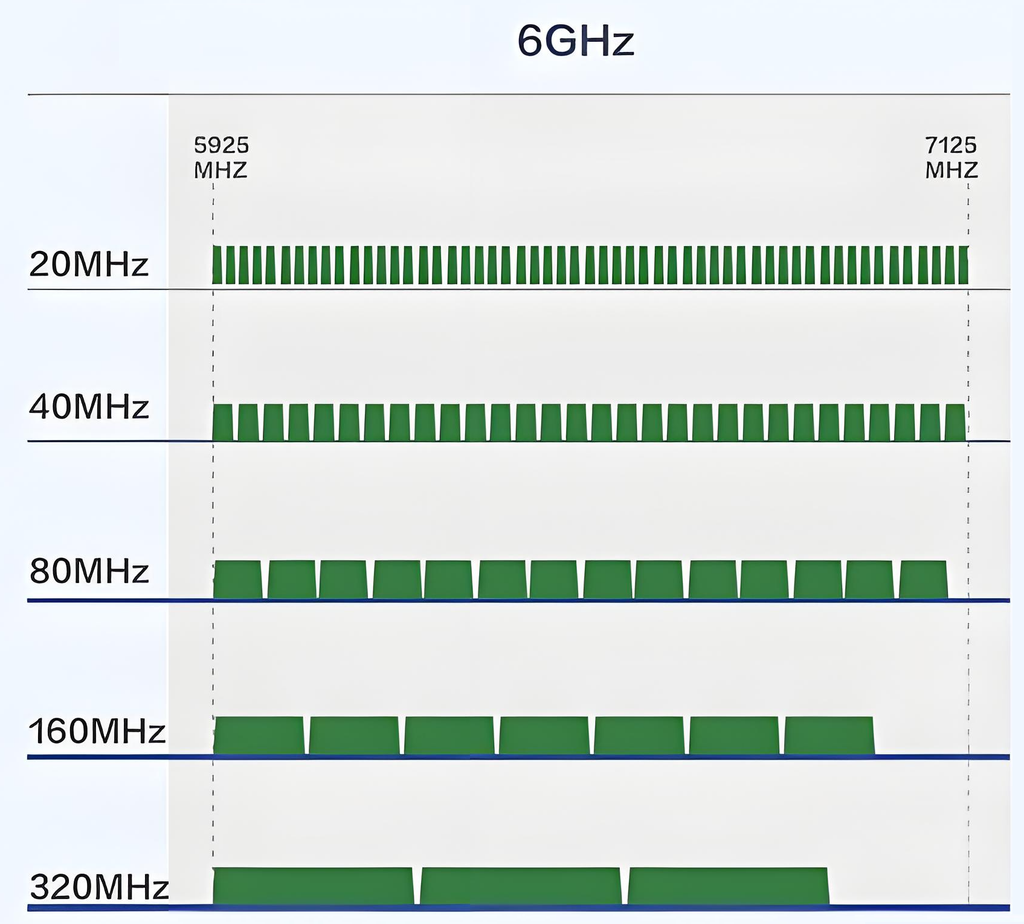
| 6 | 5.925–7.125 | 59 (20 MHz) / 29 (40MHz) / 14 (80 MHz) / 7 (160 MHz)/ 3 (320 MHz | Cleanest, widest channels; Wi-Fi 6E/7 only; poor penetration; regulatory rollout varies by country |
2. The 2.4 GHz Band
2.1 Channel Layout
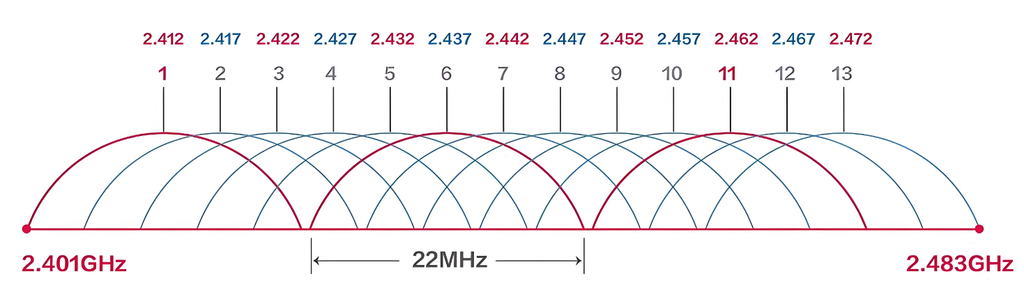

- Channel spacing: 5 MHz (except channel 14)
- Channel width: 20 MHz standard (older 802.11b devices may use 22 MHz)
- Channel count: 1–13 (most of the world); channel 14 is allowed only in Japan (2.484 GHz, 802.11b only)
2.2 The Critical Problem: Non-Overlapping Channels
Each 20 MHz channel in fact occupies roughly 22 MHz of spectrum, so only channels spaced 5 apart avoid overlapping.
There are only 3 fully non-overlapping 20 MHz channels on 2.4 GHz:
- 1, 6, 11 (the standard recommendation in North America and China)
- Some European deployments use 1, 5, 9, 13 (4-channel scheme; edges overlap slightly but remain usable)
If you and your neighbours are all crammed onto channel 6, 2.4 GHz throughput will drop dramatically — this is the fundamental reason 2.4 GHz often feels sluggish in dense environments.
2.3 Practical Recommendations
- Use 5 GHz instead of 2.4 GHz whenever possible
- If you must use 2.4 GHz, stick to 20 MHz channel width (never open 40 MHz — it overlaps with neighbouring channels entirely)
- Pick one of 1, 6, 11 — whichever your neighbours are not using
3. The 5.8 GHz Band
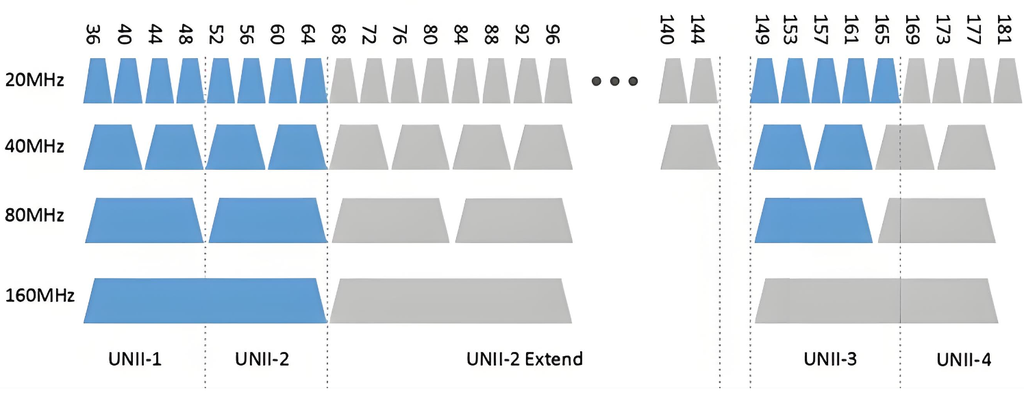
5GHz is divided into several sub-bands with different regulatory requirements.
3.1 U-NII Sub-bands and Layout
| Sub-band | Frequency Range | Channel Range | DFS? | Characteristics | China Zone |
|---|---|---|---|---|---|
| U-NII-1 | 5.150–5.250 GHz | 36, 40, 44, 48 | ❌ | Indoor-only (US); no DFS; clean | ✅ available |
| U-NII-2 | 5.250–5.350 GHz | 52, 56, 60, 64 | ✅ | DFS + TPC required | ✅ available |
| U-NII-2e | 5.470–5.725 GHz | 100–144 | ✅ | The band with the most DFS channels | ❌ not opened |
| U-NII-3 | 5.725–5.850 GHz | 149–165 | ❌ | No DFS; the most stable high-speed band | ✅ available |
| U-NII-4 | 5.850–5.925 GHz | 169–181 | ❌ | Newer allocation; partial device support | ❌ not opened |
- Routers sold in China therefore typically expose only the 36–64 and 149–165 groups; the 100–144 range in between is hidden by regulation, not by hardware limitation.
3.2 DFS (Dynamic Frequency Selection)
DFS channels share spectrum with weather and military radar. An AP must listen for 60 seconds (or longer) before using such a channel, and must vacate immediately if radar is detected during operation (Channel Availability Check + In-Service Monitoring).
Practical impact of DFS:
- APs introduce a 30–60 second scan delay at startup before the 5 GHz network becomes available
- Near radar sources (airports, harbours), channel-hopping can be frequent
- Some older devices and low-end IoT gear do not support DFS and cannot join these channels
Non-DFS channels (always available): 36, 40, 44, 48, 149, 153, 157, 161, 165
4. The 6 GHz Band (Wi-Fi 6E / Wi-Fi 7)
4.1 Why 6 GHz Is Revolutionary
- 1200 MHz of continuous spectrum (5.925–7.125 GHz in the US) — wider than 2.4 GHz and 5 GHz combined
- No DFS requirement (no radar sharing today)
- Up to 7 non-overlapping 160 MHz channels (versus only 1–2 on 5 GHz, usually requiring DFS)
- Channel numbering starts at 1, with a step of 4 (1, 5, 9, 13 … 233)
4.2 Sub-band Breakdown and Layout (US FCC, U-NII-5 through U-NII-8)
| Sub-band | Frequency Range | Channels | Notes |
|---|---|---|---|
| U-NII-5 | 5.925–6.425 GHz | 1–93 | First to open globally |
| U-NII-6 | 6.425–6.525 GHz | 97–113 | |
| U-NII-7 | 6.525–6.875 GHz | 117–185 | |
| U-NII-8 | 6.875–7.125 GHz | 189–233 |
⚠️ Mainland China 6 GHz status (as of early 2026): 6 GHz has not yet been formally opened for Wi-Fi use. The band is currently allocated primarily to licensed mobile and satellite services. Some vendors shipping “Wi-Fi 7 routers” in China ship with 6 GHz disabled in firmware. When buying domestically, you should confirm whether 6 GHz is unlocked — it is common to find it missing on devices sold in China.
The EU has opened only 5.945–6.425 GHz (~500 MHz, the lower half of U-NII-5), so European Wi-Fi 6E devices have only about 24 twenty-MHz channels and 3 one-sixty-MHz channels — far fewer than in the US.
5. Practical recommendations:
- 2.4 GHz: lock to 20 MHz
- 5 GHz: 80 MHz is the sweet spot (balanced throughput and interference); 160 MHz only at short range in clean environments
- 6 GHz: start at 80 MHz, 160 MHz is the daily-workhorse, 320 MHz reserved for extreme scenarios
6. Band, Channel, Frequency Reference
| WiFi | CH BW | Channel and Frequency | ||||||||||||||||
| 2.4 GHz | 20MHz | Channel | 1 | 2 | 3 | 4 | 5 | 6 | 7 | 8 | 9 | 10 | 11 | 12 | 13 | 14 | ||
| Frequency/MHz | 2412 | 2417 | 2422 | 2427 | 2432 | 2437 | 2442 | 2447 | 2452 | 2457 | 2462 | 2467 | 2472 | 2484 | ||||
| 40MHz | Channel | 3 | 4 | 5 | 6 | 7 | 8 | 9 | 10 | 11 | ||||||||
| Frequency/MHz | 2422 | 2427 | 2432 | 2437 | 2442 | 2447 | 2452 | 2457 | 2462 | |||||||||
| 5 GHz Low | 20MHz | Channel | 36 | 40 | 44 | 48 | 52 | 56 | 60 | 64 | ||||||||
| Frequency/MHz | 5180 | 5200 | 5220 | 5240 | 5260 | 5280 | 5300 | 5320 | ||||||||||
| 40MHz | Channel | 38 | 42 | 46 | 50 | 54 | 58 | 62 | ||||||||||
| Frequency/MHz | 5190 | 5210 | 5230 | 5250 | 5270 | 5290 | 5310 | |||||||||||
| 80MHz | Channel | 42 | 58 | |||||||||||||||
| Frequency/MHz | 5210 | 5290 | ||||||||||||||||
| 160MHz | Channel | 50 | ||||||||||||||||
| Frequency/MHz | 5250 | |||||||||||||||||
| 5 GHz Mid | 20MHz | Channel | 100 | 104 | 108 | 112 | 116 | 120 | 124 | 128 | 132 | 136 | 140 | |||||
| Frequency/MHz | 5500 | 5520 | 5540 | 5560 | 5580 | 5600 | 5620 | 5640 | 5660 | 5680 | 5700 | |||||||
| 40MHz | Channel | 102 | 106 | 110 | 114 | 118 | 122 | 126 | 130 | 134 | 138 | |||||||
| Frequency/MHz | 5510 | 5530 | 5550 | 5570 | 5590 | 5610 | 5630 | 5650 | 5670 | 5690 | ||||||||
| 80MHz | Channel | 106 | 122 | |||||||||||||||
| Frequency/MHz | 5530 | 5610 | ||||||||||||||||
| 160MHz | Channel | 114 | ||||||||||||||||
| Frequency/MHz | 5570 | |||||||||||||||||
| 5 GHz High | 20MHz | Channel | 149 | 153 | 157 | 161 | 165 | |||||||||||
| Frequency/MHz | 5745 | 5765 | 5785 | 5805 | 5825 | |||||||||||||
| 40MHz | Channel | 151 | 155 | 159 | 163 | |||||||||||||
| Frequency/MHz | 5755 | 5775 | 5795 | 5815 | ||||||||||||||
| 80MHz | Channel | 155 | ||||||||||||||||
| Frequency/MHz | 5775 | |||||||||||||||||
| 6E U-NII-5: 5925-6425MHz U-NII-6: 6425-6525MHz U-NII-7: 6525-6875MHz U-NII-8: 6875-7125MHz | 20MHz | Channel | 1 | 5 | 9 | 13 | 17 | 21 | 25 | 29 | 33 | 37 | 41 | 45 | 49 | 53 | 57 | 61 |
| Frequency/MHz | 5955 | 5975 | 5995 | 6015 | 6035 | 6055 | 6075 | 6095 | 6115 | 6135 | 6155 | 6175 | 6195 | 6215 | 6235 | 6255 | ||
| 40MHz | Channel | 3 | 11 | 19 | 27 | 35 | 43 | 51 | 59 | |||||||||
| Frequency/MHz | 5965 | 6005 | 6045 | 6085 | 6125 | 6165 | 6205 | 6245 | ||||||||||
| 80MHz | Channel | 7 | 23 | 39 | 55 | |||||||||||||
| Frequency/MHz | 5985 | 6065 | 6145 | 6225 | ||||||||||||||
| 160MHz | Channel | 15 | 47 | |||||||||||||||
| Frequency/MHz | 6025 | 6185 | ||||||||||||||||
| 20MHz | Channel | 65 | 69 | 73 | 77 | 81 | 85 | 89 | 93 | 97 | 101 | 105 | 109 | 113 | 117 | 121 | 125 | |
| Frequency/MHz | 6275 | 6295 | 6315 | 6335 | 6355 | 6375 | 6395 | 6415 | 6435 | 6455 | 6475 | 6495 | 6515 | 6535 | 6555 | 6575 | ||
| 40MHz | Channel | 67 | 75 | 83 | 91 | 99 | 107 | 115 | 123 | |||||||||
| Frequency/MHz | 6285 | 6325 | 6365 | 6405 | 6445 | 6485 | 6525 | 6565 | ||||||||||
| 80MHz | Channel | 71 | 87 | 103 | 119 | |||||||||||||
| Frequency/MHz | 6305 | 6385 | 6465 | 6545 | ||||||||||||||
| 160MHz | Channel | 79 | 111 | |||||||||||||||
| Frequency/MHz | 6345 | 6505 | ||||||||||||||||
| 20MHz | Channel | 129 | 133 | 137 | 141 | 145 | 149 | 153 | 157 | 161 | 165 | 169 | 173 | 177 | 181 | 185 | 189 | |
| Frequency/MHz | 6595 | 6615 | 6635 | 6655 | 6675 | 6695 | 6715 | 6735 | 6755 | 6775 | 6795 | 6815 | 6835 | 6855 | 6875 | 6895 | ||
| 40MHz | Channel | 131 | 139 | 147 | 155 | 163 | 171 | 179 | 187 | |||||||||
| Frequency/MHz | 6605 | 6645 | 6685 | 6725 | 6765 | 6805 | 6845 | 6885 | ||||||||||
| 80MHz | Channel | 135 | 151 | 167 | 183 | |||||||||||||
| Frequency/MHz | 6625 | 6705 | 6785 | 6865 | ||||||||||||||
| 160MHz | Channel | 143 | 175 | |||||||||||||||
| Frequency/MHz | 6665 | 6825 | ||||||||||||||||
| 20MHz | Channel | 193 | 197 | 201 | 205 | 209 | 213 | 217 | 221 | 225 | 229 | 233 | ||||||
| Frequency/MHz | 6915 | 6935 | 6955 | 6975 | 6995 | 7015 | 7035 | 7055 | 7075 | 7095 | 7115 | |||||||
| 40MHz | Channel | 195 | 203 | 211 | 219 | 227 | ||||||||||||
| Frequency/MHz | 6925 | 6965 | 7005 | 7045 | 7085 | |||||||||||||
| 80MHz | Channel | 199 | 215 | |||||||||||||||
| Frequency/MHz | 6945 | 7025 | ||||||||||||||||
| 160MHz | Channel | 207 | ||||||||||||||||
| Frequency/MHz | 6985 | |||||||||||||||||
| 1、IEEE Std 802.11-2012:17.4.6.3 Channel Numbering of operating channels | ||||||||||||||||||
| 2、https://support.huawei.com/enterprise/zh/doc/EDOC1100198080/ | ||||||||||||||||||
| 3、https://www.litepoint.com/blog/wi-fi-6e-standard-and-channels/ | ||||||||||||||||||
| 3、https://en.wikipedia.org/wiki/List_of_WLAN_channels | ||||||||||||||||||