
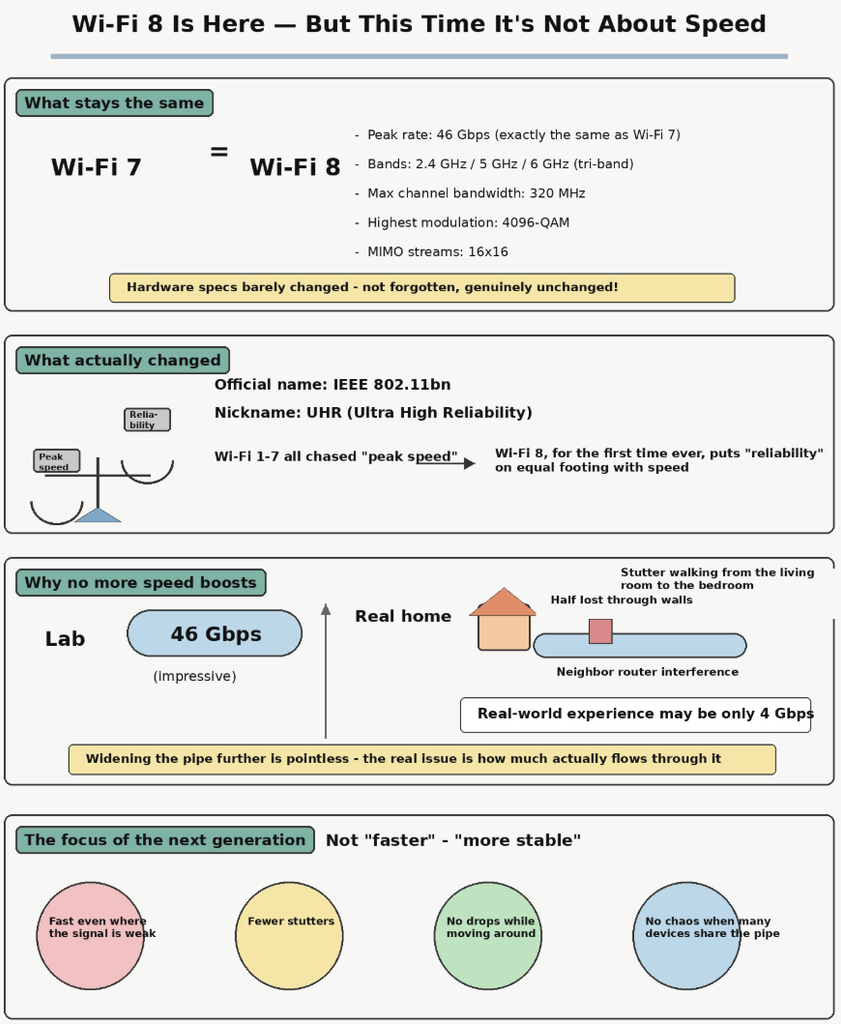
1. The Features from WiFi7 to WiFi8
| Feature | Wi-Fi 7 | Wi-Fi 8 |
|---|---|---|
| IEEE standard | 802.11be | 802.11bn (UHR) |
| Main goal | Extremely High Throughput | Ultra-High Reliability |
| Max PHY rate | ~23–46 Gbps | ~23–46 Gbps |
| Max channel bandwidth | 320 MHz | 320 MHz |
| Frequency bands | 2.4 / 5 / 6 GHz | 2.4 / 5 / 6 GHz, with 6 GHz slightly extended |
| Modulation | 4096-QAM | 4096-QAM |
| Spatial streams | Up to 8 | Up to 8 |
| Key new feature | Multi-Link Operation (MLO) | Multi-AP Coordination, Seamless Mobility Domain, Enhanced Long Range |
| Availability | Available now | Expected around 2028 |
1.1 What Wi-Fi 7 is good at
Wi-Fi 7 focuses on higher speed and lower latency. Its biggest improvements are:
- 320 MHz channels for much wider bandwidth.
- 4096-QAM modulation, carrying more data per signal.
- Multi-Link Operation (MLO), allowing devices to use multiple bands at the same time.
- Better performance in crowded networks with many devices.
Wi-Fi 7 is currently the best mainstream choice for high-performance home and office networks.
1.2. What Wi-Fi 8 changes
Wi-Fi 8 does not mainly increase peak speed. Instead, it focuses on Ultra-High Reliability (UHR).
Its main goals are:
- More stable connections in complex environments.
- Lower latency jitter, especially for the worst 5% of cases.
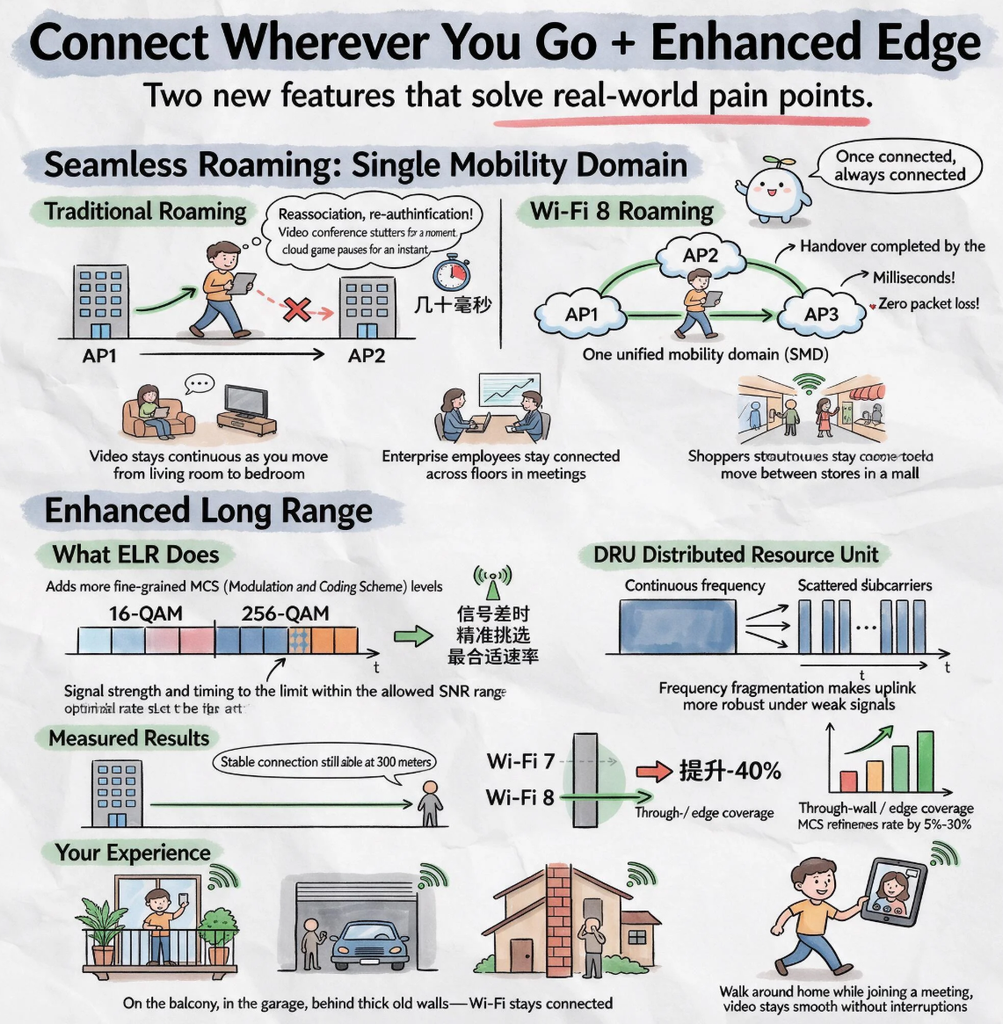
- Fewer packet drops during roaming.
- Better performance in dense networks such as factories, offices, hospitals, and large homes with many devices.
2. Key Wi-Fi 8 technologies
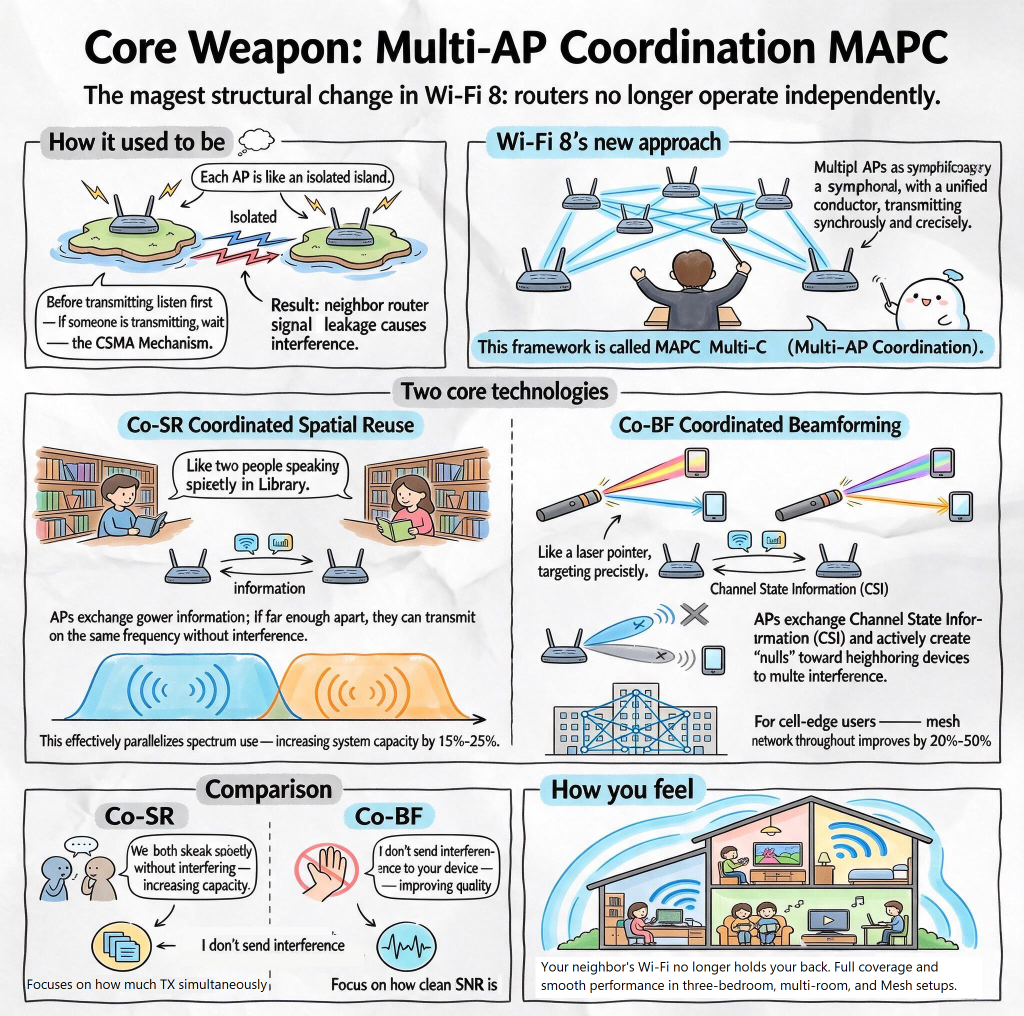
- Multi-AP Coordination (MAPC): Multiple access points work together instead of interfering with each other.
- Coordinated Spatial Reuse (Co-SR) and Coordinated Beamforming (Co-BF): Reduce interference and improve efficiency in dense environments.
- Seamless Mobility Domain (SMD): Enables near-zero packet loss when moving between APs.
- Enhanced Long Range (ELR): Improves coverage for devices at the edge of the network.
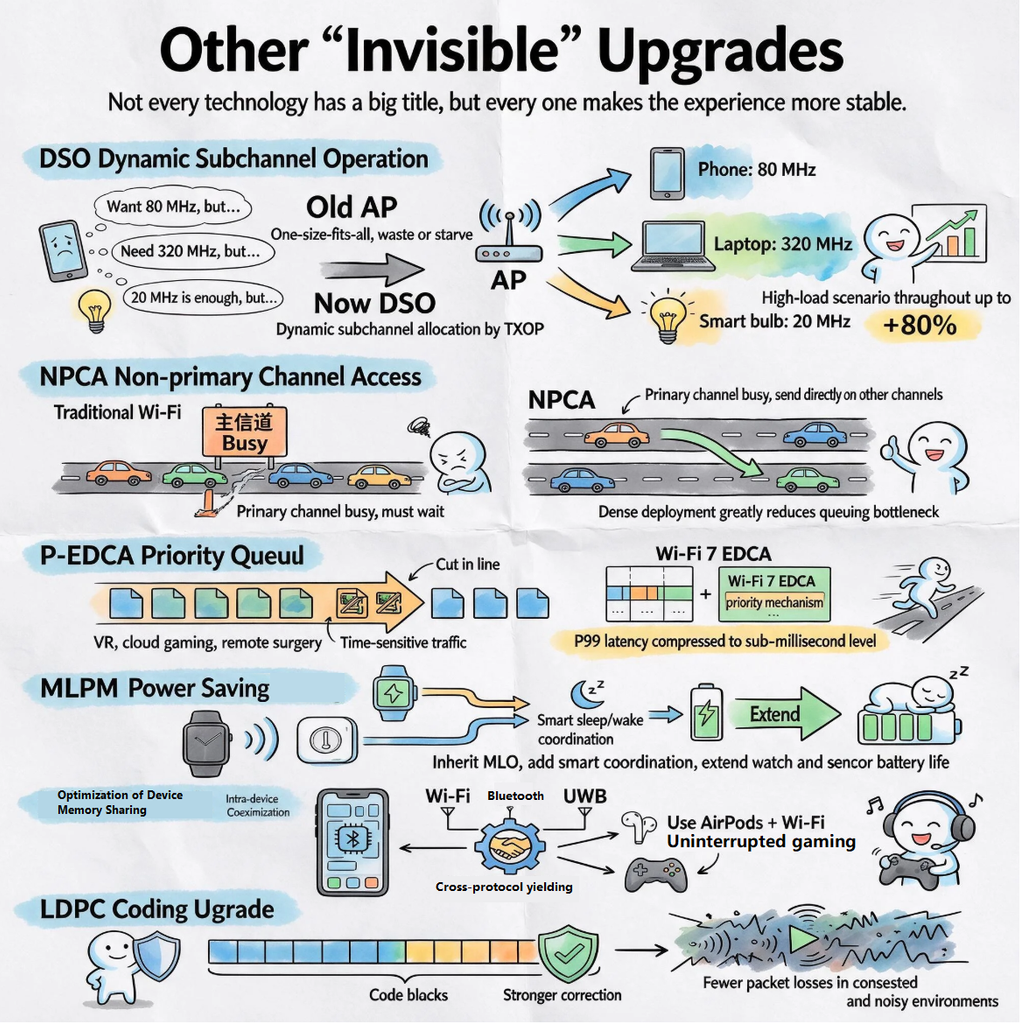
- Dynamic Sub-channel Operation (DSO): Allocates spectrum resources more flexibly.
3. Which one should you choose?
- If you are buying a router now: Wi-Fi 7 is the better choice. It is mature, widely available, and already very fast.
- If you need stable roaming, low jitter, or enterprise/industrial reliability: Wi-Fi 8 will be more relevant, but consumer devices are not widely available yet.
- If you already have Wi-Fi 6 or Wi-Fi 7: There is no urgent need to wait for Wi-Fi 8 for normal home use.