Modulation is the process of varying one or more properties of a high-frequency carrier signal in accordance with a lower-frequency baseband (message) signal, so that the information can be efficiently transmitted over a physical channel such as air, cable, or optical fiber. Modulation is the mapping from information to a transmittable waveform.
I/Q Modulation
Modern wireless systems such as Wi-Fi, 4G, and 5G often use I/Q modulation.
Where:
- : in-phase component
- Q(t) : quadrature component
This can also be written as:
The complex baseband signal is:
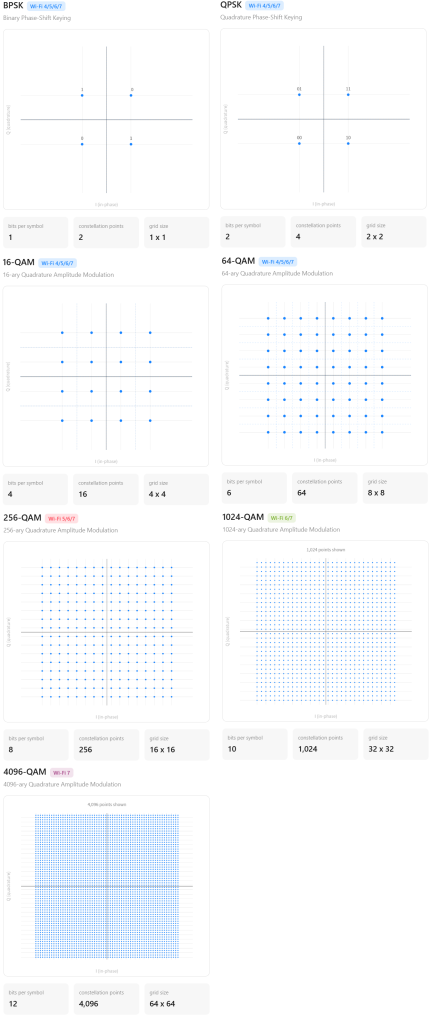
Each point on the constellation diagram corresponds to one value of .
QAM Example
For M-QAM, each symbol carries:
bits.
Examples:
| Modulation | Bits per symbol |
|---|---|
| QPSK / 4-QAM | 2 |
| 16-QAM | 4 |
| 64-QAM | 6 |
| 256-QAM | 8 |
| 1024-QAM | 10 |
| 4096-QAM | 12 |
For example, in 16-QAM, each symbol represents:
bits.
Symbol Rate and Bit Rate
If the symbol rate is:
Then the bit rate is:
Where:
- : bit rate
- : symbol rate
- : modulation order
So higher-order modulation increases data rate, but usually requires higher SNR.
The modulation schemes in Wi-Fi 4/5/6/7
| Standard | Modulation Schemes | Highest Order |
|---|---|---|
| Wi-Fi 4 (802.11n) | BPSK, QPSK, 16-QAM, 64-QAM | 64-QAM |
| Wi-Fi 5 (802.11ac) | BPSK, QPSK, 16-QAM, 64-QAM, 256-QAM | 256-QAM |
| Wi-Fi 6 (802.11ax) | BPSK, QPSK, 16-QAM, 64-QAM, 256-QAM, 1024-QAM | 1024-QAM |
| Wi-Fi 7 (802.11be) | BPSK, QPSK, 16-QAM, 64-QAM, 256-QAM, 1024-QAM, 4096-QAM | 4096-QAM |
The constellation diagram in Wi-Fi 4/5/6/7