
This article will describe the WLAN history, the explaination of MIMO, MU-MIMO, OFDM, OFMDA and their relationship.
WLAN History
| Year | Generation | WLAN Standard | Wi-Fi Frequency | Backward compatible |
| 1999 | Wi-Fi1 | 802.11b | 2.4GHz | N/A |
| 1999 | Wi-Fi2 | 802.11a | 5GHz | N/A |
| 2003 | Wi-Fi3 | 802.11g | 2.4GHz | Wi-Fi1 |
| 2009 | Wi-Fi4 | 802.11n | 2.4G & 5GHz | Wi-Fi1/2/3 |
| 2013 | Wi-Fi5 | 802.11ac | 5GHz | Wi-Fi1/2/3/4 |
| 2019 | Wi-Fi6/6E | 802.11ax | 2.4G & 5GHz | Wi-Fi1/2/3/4/5 |
| 2022 | Wi-Fi7 | 802.11be | 2.4G & 5G & 6GHz | Wi-Fi1/2/3/4/5/6 |
| 2028 | Wi-Fi8 | 802.11bn | 2.4G & 5G & 6GHz | Wi-Fi1/2/3/4/6/7 |
Spatial Stream of MIMO
Since IEEE802.11n (Wi-Fi4), MIMO (Multiple-Input Multiple-Output)is phased in to improve the Wi-Fi throughput capacity under the same conditions of power and bandwidth. It is to use multi-antennas to transmit and to receive data at the same time.
Normally MIMO will use MTNR or MxN to describe its antennas. M means Tx antenna Qty while N means Rx antenna Qty. In a broad sense, SIMO (Single-Input Multiple-Output) and MISO (Multiple-Input Single-Output) also fall under the category of MIMO. Note: 1 antenna could used to transimit and receive data at the same time. So normally 1 antenna represents 1×1.
The total Bitrate of Steam for different MxN antennas in Wi-Fi4/5/6.
| MIMO | Wi-Fi4 (40MHz) | Wi-Fi5 (80MHz) | Wi-Fi6 (160MHz) |
| 1×1 | 150Mbps | 433Mbps | 1201Mbps |
| 2×2 | 300Mbps | 867Mbps | 2402Mbps |
| 3×3 | 450Mbps | 1300Mbps | 3603Mbps |
| 4×4 | 600Mbps | 1733Mbps | 4804Mbps |
| 8×8 | – | 3466Mbps | 9608Mbps |
| – | – | – | – |
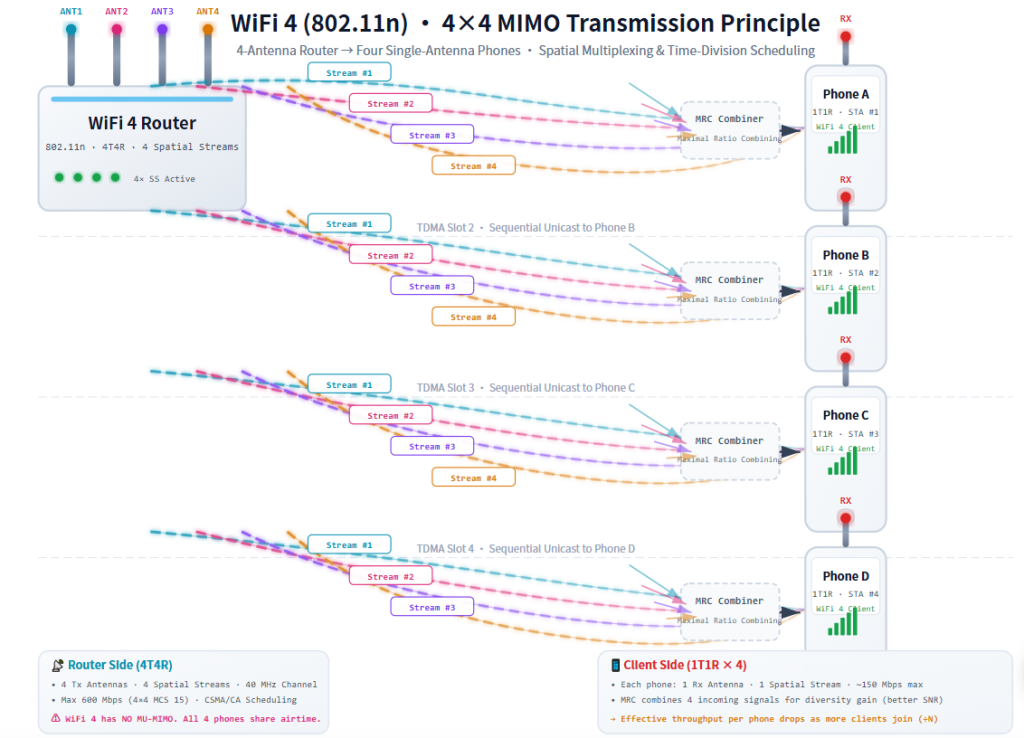
In a MIMO system, the maximum transmission capacity is determined by the number of antennas at both the transmitter and the receiver, and is limited by the side with fewer antennas. Even if the Router is equipped with 4 antennas(4×4), the phones and computers connected to it typically have only one antenna(1×1). In this case, the 4 antennas on the Router can only transmit the same data simultaneously at any given time, which improves transmission reliability but does not increase the data rate.(So traditionally MIMO is only means SU-MIMO, Single User MIMO.) However, since the 4-antenna device enhances transmission reliability through diversity techniques, the number of retransmissions is reduced (enhance the SNR, QoS), giving users the perception of faster speeds.
Below diagram is the to show how it works between 4×4 WiFi4 Router and four 1×1 WiFi4 Mobile phones. Even though Router supprts up to 600Mbps throughput capacity, but each phone only get the effective throughput of 1/4 of 150Mbps.
MU-MIMO
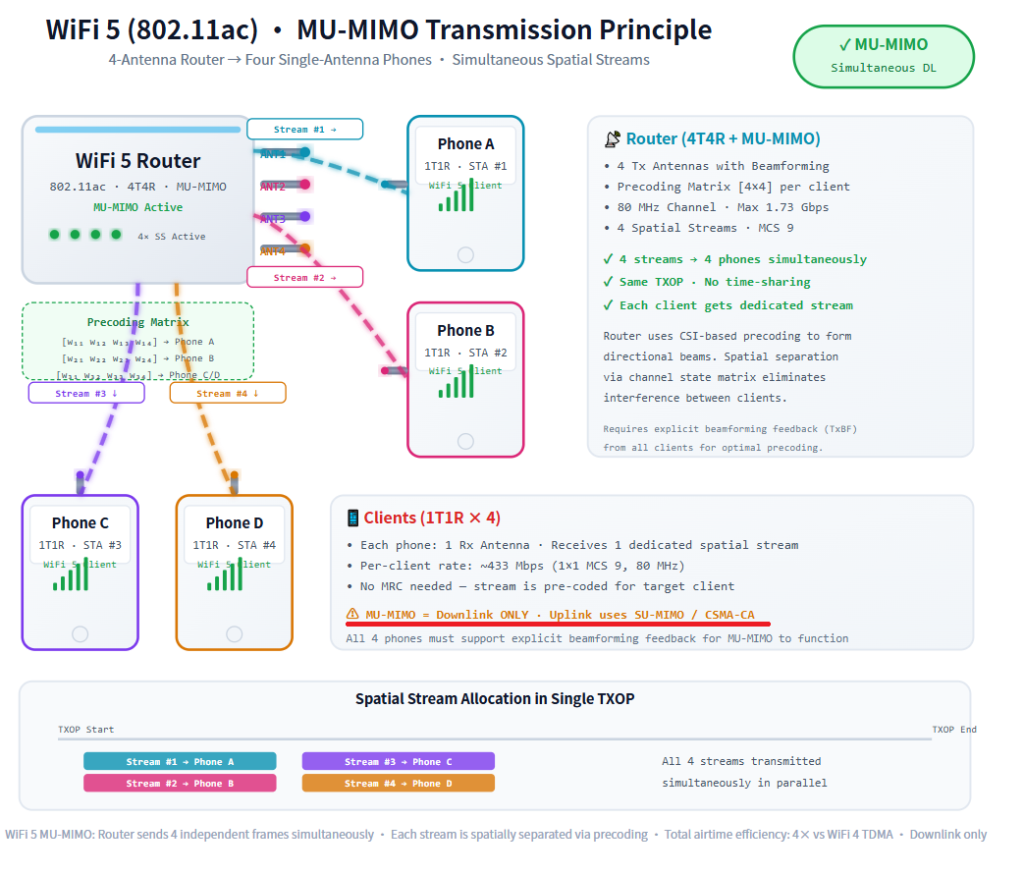
To solve the low effective throughput of airtime share problem, Wi-Fi5 phased in the the new methods of Multi-User MIMO in DownLink. It meas each antenna of 4×4 router could send stream to each 1×1 client device simultaneously.
Below diagram is to show how it works between 4×4 WiFi5 Router and four 1×1 WiFi5 Mobile phones. Each mobile phones could get the full throughput of 433Mbps in 5GHz channel simultaneously in downLink. But need to clalify that, the UpLink of WiFi5 modible phone is still SU-MIMO like WiFi4. Its effective throughput is still 1/4 of 433Mbps in 5GHz channel.
UL & DL MU-MIMO + OFDMA
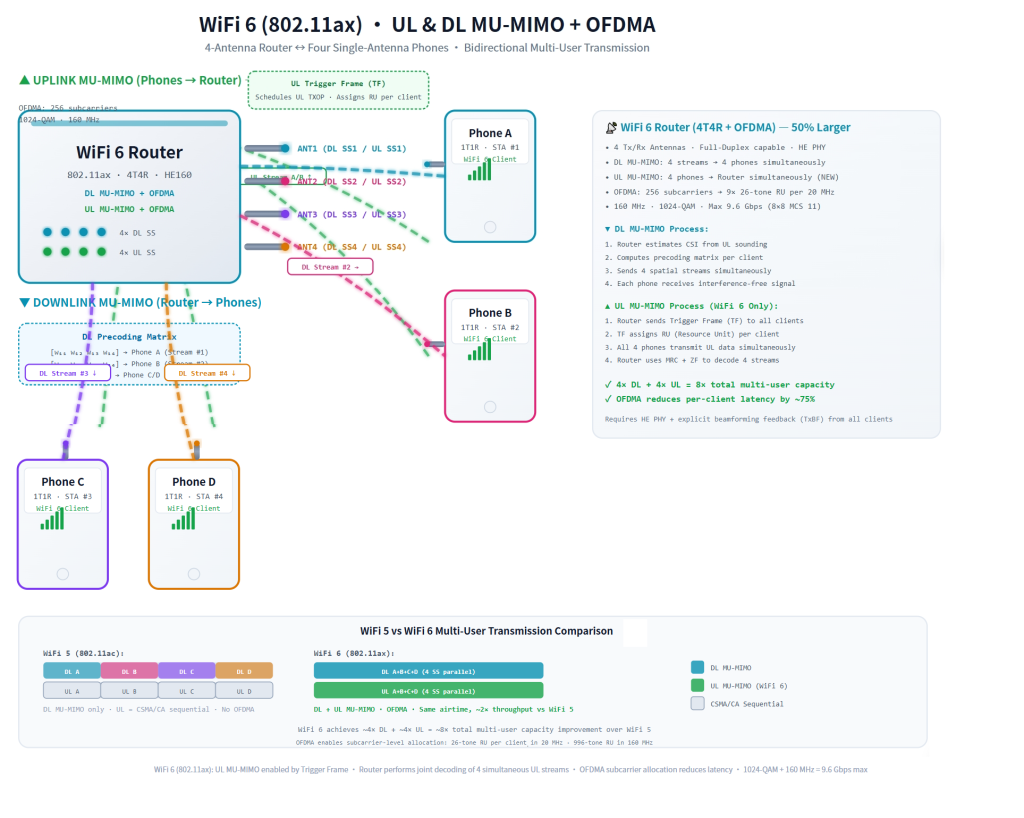
Continue to solve the low effective throughput of Wi-Fi5 UL SU-MIMO. Wi-Fi6 phased in the UL MU-MIMO as same as DL MU-MIMO method and OFDMA to implement the tramsmitting and receiving data simultaneously.
Below diagram is to show how it works between 4×4 WiFi6 Router and four 1×1 WiFi6 Mobile phones. Each mobile phones could get the full throughput of 1201Mbps in 5GHz channel simultaneously in both UPLINK and DOWNLINK.
OFDM vs OFMDA
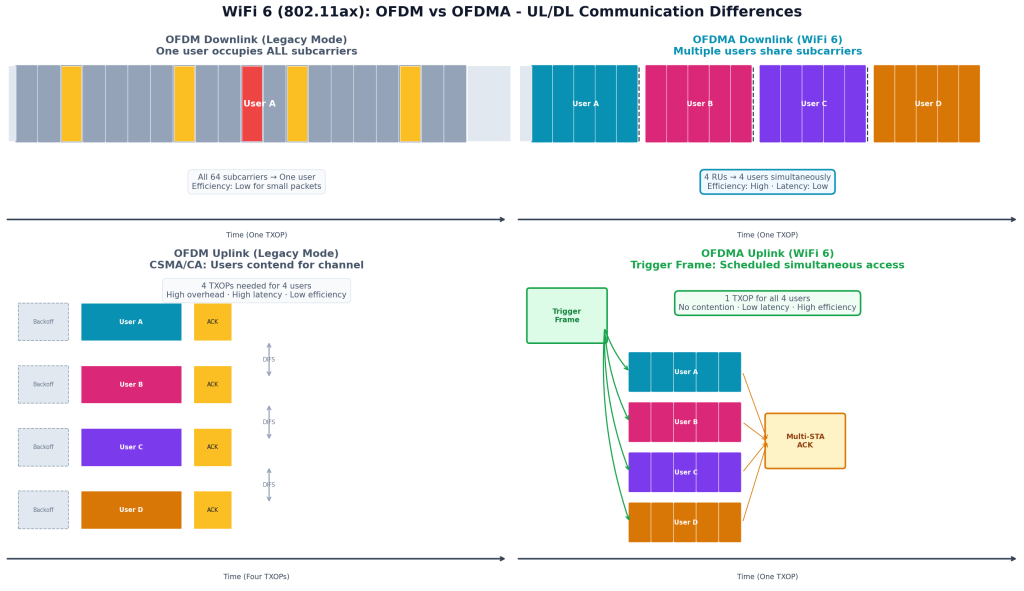
| OFDM (Legacy) | OFDMA (WiFi 6) | |
|---|---|---|
| Downlink | One user occupies ALL 64 subcarriers. Low efficiency for small packets. | 4 RUs (Resource Units) allocated to 4 users simultaneously. High efficiency, low latency. |
| Uplink | CSMA/CA contention. 4 TXOPs needed for 4 users. High overhead, high latency, low efficiency. | Trigger Frame schedules all 4 users in one TXOP. No contention, low latency, high efficiency. Multi-STA ACK. |
Key Differences:
- OFDM: Entire channel bandwidth goes to one user at a time
- OFDMA: Channel divided into RUs (26/52/106/242/484/996-tone), serving multiple users in parallel
- RU (Resource Unit): The minimum unit of subcarrier allocation in OFDMA
MU-MIMO vs OFDMA
OFDMA and UL MU-MIMO is phased in Wi-Fi6. So below diagram is to the difference between MU-MIMO and OFDMA in Wi-Fi6 situation.
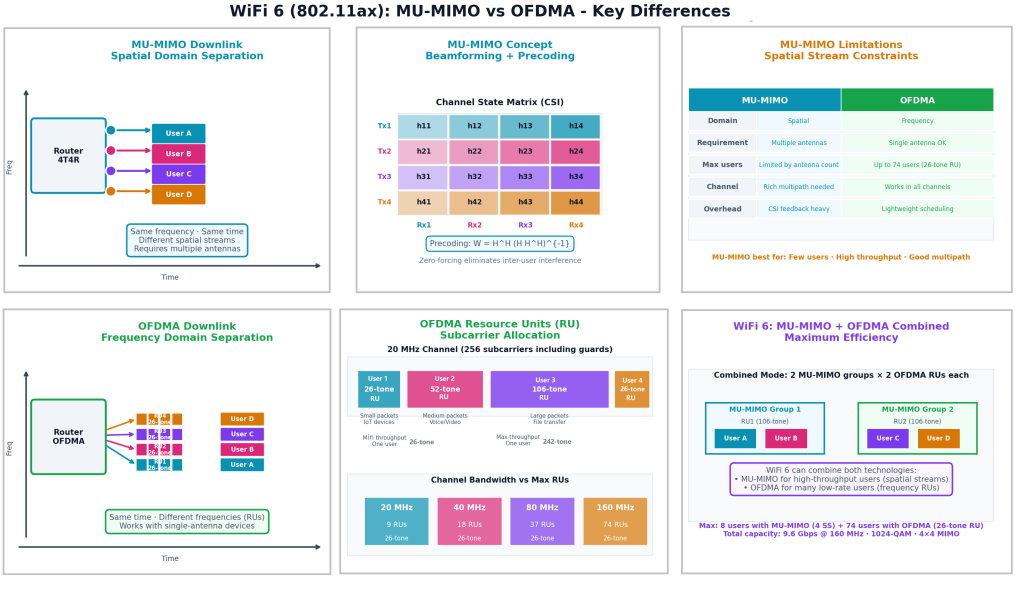
| Wi-Fi6 | MU-MIMO | OFDMA |
|---|---|---|
| Separation Domain | Spatial Domain | Frequency Domain |
| Principle | Beamforming + Precoding Matrix, Different Spatial Streams | Channel divided into RUs (Resource Units), Different Frequency Subcarriers |
| Antenna Requirement | Requires Multiple Antennas | Single Antenna Sufficient |
| Max Users | Limited by Antenna Count (4T4R = 4 users) | Up to 74 users (26-tone RU @ 160 MHz) |
| Use Cases | High Throughput, Few Users, Rich Multipath | Many Users, Small Packets, IoT Devices |
| Overhead | Heavy CSI Feedback | Lightweight Scheduling |